 Green Technology Global
Stop waiting for the grid.
Independent power + water infrastructure designed around your campus requirements. Start with MW, water demand, utility status and target energization—not with a technology brochure.
When infrastructure timing becomes project timing
For a developer, power and water are not abstract sustainability issues. They are site-development variables that can affect viability, schedule and operating risk.
Utility timing
Is the required power available when the campus must energize?
Resource capacity
Can the site support the planned MW and water profile at the required scale?
Resiliency
Where does infrastructure dependence create a single point of project or operating risk?
Data centers are now critical infrastructure
As AI, cloud and defense-adjacent workloads concentrate inside data center campuses, the power and water systems that keep them running have become a national security concern, not just an operating expense.
- A single grid interconnection or a single municipal water source is a single point of failure—for the facility, and for the government, financial and communications systems that increasingly depend on it.
- Distributed, on-site power generation keeps campuses operational independent of grid congestion and transmission bottlenecks.
- On-site water generation removes exposure to regional water stress and municipal supply constraints.
- Critical workloads gain a resiliency posture that aligns with how federal agencies and utilities are already thinking about infrastructure hardening.
Independence is also good neighborship
GTG believes data center developers and operators have a responsibility to their host communities, not just their tenants. Emerging regulatory frameworks aimed at hyperscale data center growth increasingly call for developers to:
- Fund their own grid build-outs rather than shifting transmission and capacity costs onto local ratepayers.
- Bring new clean generation to the grid rather than drawing down existing capacity.
- Own and operate a micro-grid that runs independent of utility infrastructure, at zero operating emissions.
- Site and baffle equipment to avoid noise impact on nearby residents.
- Draw water from the atmosphere rather than local aquifers or municipal supply.
- Support cumulative impact assessment, transparency and community benefit commitments.
A campus that owns and operates its own micro-grid and on-site water generation is built for that standard from day one.
An open letter to communities and operators
GTG has published an open letter addressing the standoff that often forms around new data center projects—laying out residents' concerns about power costs, water draw and noise alongside operators' concerns about interconnection timelines and water access, and proposing on-site power, atmospheric water generation and closed-loop wastewater treatment as a practical middle path.
Read the Open Letter →Power and water should be evaluated together
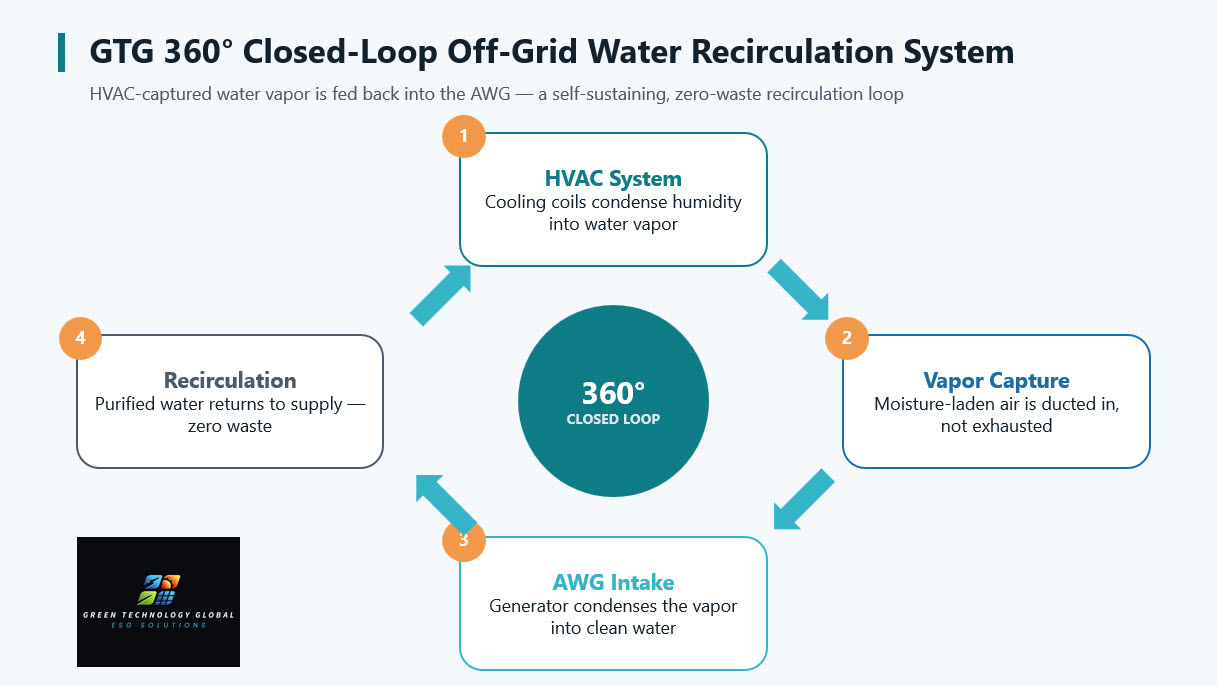
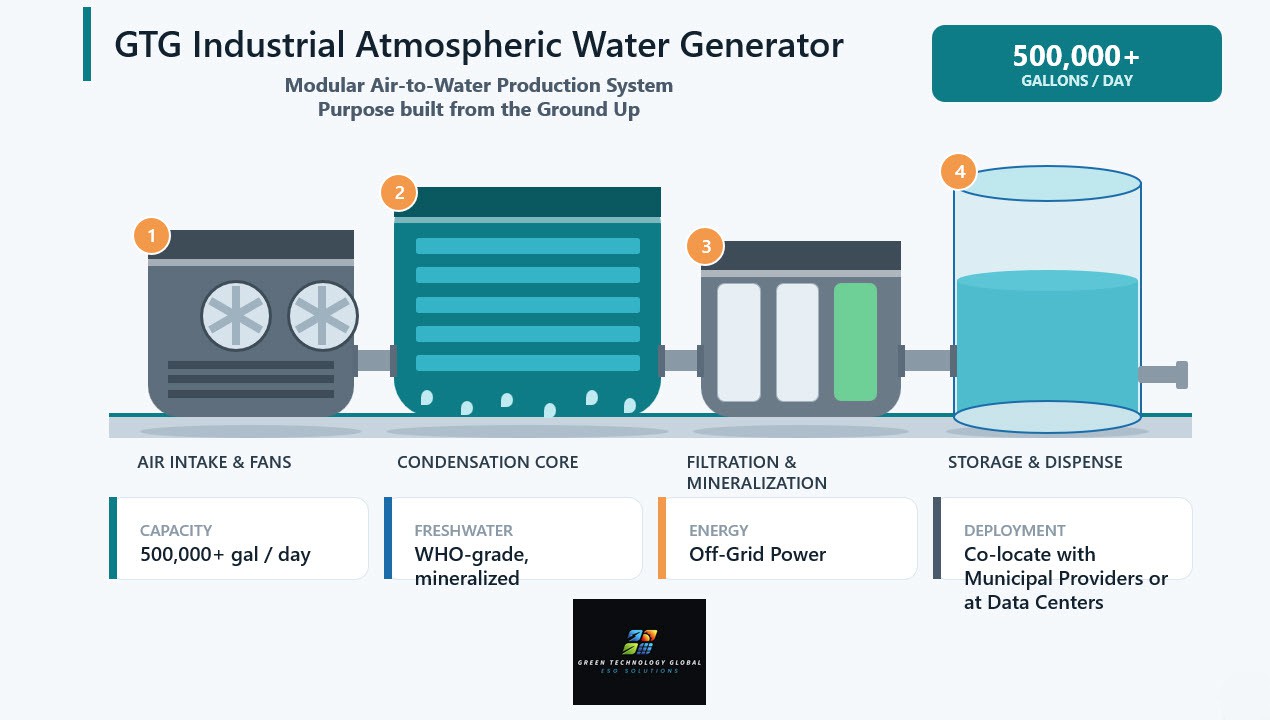
GTG's approach is to evaluate a campus as an infrastructure system. Depending on the project, that can include distributed generation, atmospheric water generation, water storage, vapor recovery and associated resiliency technologies.
MODELED PER PROJECTMODULARTECHNICAL REVIEW REQUIRED
Make diligence easy
Rather than burying buyers in slides, the core page points directly to the material a technical team can review.
PTE Data Center Deck
Power architecture, turbine concept and data-center application.
Open technical presentation →Data Center Water Recovery
Water vapor recovery concept for data-center environments.
Open recovery document →Source of Your Water
Background material on data-center water sourcing and GTG's alternative approach.
Open case study →Microgrids Run by Markets
Transactive energy operating system for balancing on-site power, storage and AI workloads without central control.
Open executive overview → · Read the blog post →A defined path to a decision
Site + schedule
Location, development stage and target operational date.
Load profile
MW requirement, expected growth and utility status.
Water profile
Daily demand, source constraints, cooling context and recovery potential.
Technical next step
Determine whether a feasibility study, engineering review or proposal is warranted.
Portable Turbine Energy + GTG water systems
Technical buyers can go deeper into power generation, natural-gas supply, AWG deployment and water-recovery material without forcing every visitor through a full presentation.
Own the infrastructure problem before selecting the technology
Research power capacity, time-to-power, onsite generation, AI infrastructure and water constraints.